October 19, 2026 · 4 min read
AI and superannuation advice: faster work, harder questions
AustralianSuper plans staged online advice; separately, regulators scrutinise AI. Where can AI help advisers without missing rollover risks?
AI paraplanning is software that automates the paraplanner's core tasks: research, strategy modelling, and draft-document production, while the adviser stays responsible. A plain-English Australian definition, with a worked example and the governance line.
AI paraplanning is the most misused phrase in Australian advice tech right now. Vendors apply it to anything with a language model attached, which means an adviser comparing two tools is often comparing a meeting transcriber to a strategy engine and being told they do the same job. They do not.
So here is the clean definition, the one worth keeping.
AI paraplanning is software that automates the core tasks of a paraplanner: research and data collection, strategy modelling and comparison, and the production of draft advice documents, while the licensed adviser remains responsible for the advice itself.
That sentence does the work. The rest of this piece defends each part of it, because the boundaries are where firms waste money.
These are three different layers. Most tools sold as "AI for advice" sit in exactly one of them, and the category they occupy determines what you should pay and what you can expect.
| Layer | What it does | Replaces | What it does not do |
|---|---|---|---|
| AI file-noting | Turns a client meeting into a structured, ASIC-aware file note | The note-taker | Strategy, modelling, the SOA |
| AI paraplanning | Research, modelling, strategy comparison, draft document production | The paraplanning step | Sign off the advice |
| AI advice generation | Produces a complete, compliant advice document end to end | The full production line | Remove the adviser's accountability |
File-noting is the narrow case. It captures what was said and shapes it into a record. Useful, and overlapping with generic transcription tools, but it stops before strategy. We cover that boundary in detail in generic AI note-takers vs adviser-specific AI and in ASIC-compliant file notes.
AI advice generation is the broad case. It runs the whole production line from fact-find to finished document inside one governed environment.
AI paraplanning is the layer in the middle, and it is the layer where most of the time savings in the category actually come from, because paraplanning is the bottleneck in most firms. Mix the three up and you will buy a transcriber when you needed a strategy engine, or pay for an advice OS when a file-note tool would have done.
Three tasks. Break them out, because a tool that does one well and the others poorly is common.
The AI pulls together the inputs a paraplanner would otherwise assemble by hand: current super and investment positions, insurance held, fees, product features, contribution caps, and the relevant thresholds for the strategy under consideration. It reads the file note and the fact-find and assembles the picture. The adviser checks it. This is where the first hour per file usually goes, and it is the most mechanical hour.
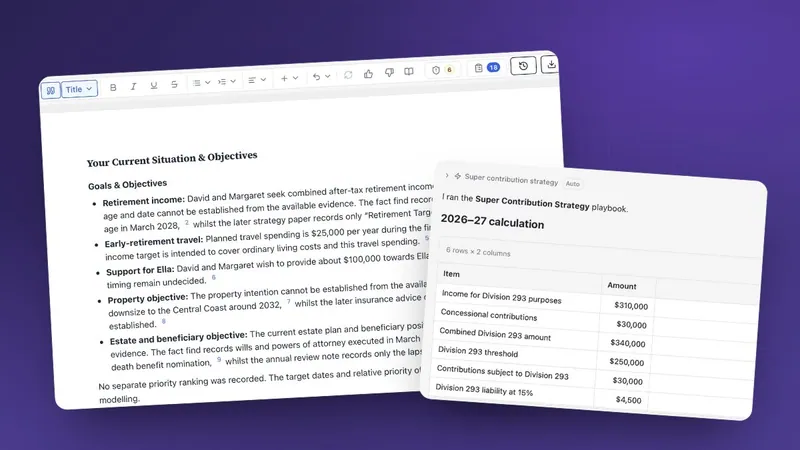
The AI runs the numbers on the options: contribution strategies, transition-to-retirement structures, debt recycling, insurance restructures, and projects the outcomes side by side. It does not decide which strategy is right. It does the arithmetic and surfaces the comparison so the adviser can exercise judgement faster.
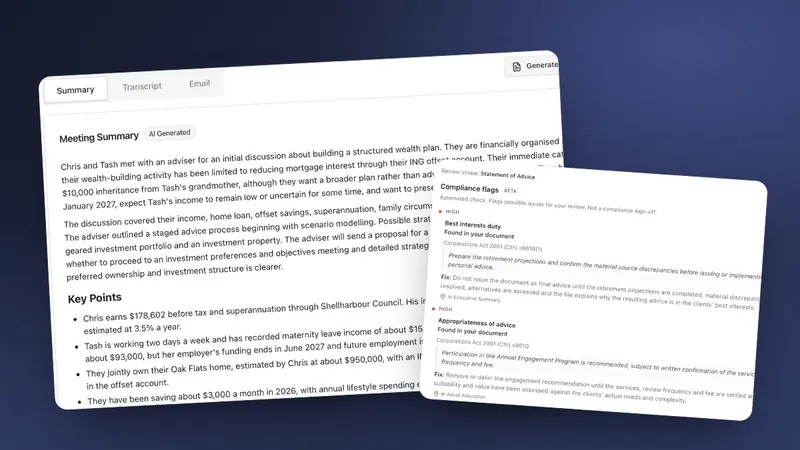
The AI writes the first draft of the advice document, the SOA or the record that replaces it, populated with the client's data, the modelled strategy, and the reasoning. The adviser edits, challenges, and signs. A first draft is not a final document, and treating it as one is the single most common way firms get AI paraplanning wrong. For how this plays out specifically in SOA production, see SOA automation and AI statement-of-advice software.
Take a 61-year-old client wanting to reduce hours and start drawing down super. Here is who does what.
The work that compressed is steps 2, 3, and 5. The judgement, steps 1, 4, and 6, did not move. That is the whole point of the layer.
This is the part vendors skip and the part ASIC cares about most.
The AI is not regulated. The advice is. ASIC's Regulatory Guide 175 places the obligation to provide appropriate advice on the licensed adviser, regardless of which tools produced the draft. No model output carries that responsibility. The adviser does.
That has two practical consequences for any tool you evaluate.
First, the adviser has to remain the decision-maker in the workflow, not a rubber stamp at the end of an automated pipeline. A tool that makes it easy to ship an unread draft is a governance problem wearing a productivity badge.
Second, the audit trail has to be complete. Under ASIC's record-keeping expectations in RG 36, the licensee should be able to reconstruct, for any piece of advice, what inputs went in and what the AI produced before the adviser touched it. One chain, not three vendor exports stitched together after the fact.
If you want a thirty-minute exercise: take your last five completed SOAs and ask whether you could show a reviewer the exact inputs and the AI's first draft for each. If you cannot, that gap is your real AI paraplanning requirement, ahead of any feature list.
A US or UK paraplanning tool can be excellent and still be wrong for an Australian licensee, for two reasons.
Data residency is the first. Client PII for advice is sensitive, and a growing number of licensees now require written confirmation of where the data sits and where the model inference runs. Onshore is increasingly a procurement filter, not a preference. Ask the question in writing.
The regulatory direction is the second. The Delivering Better Financial Outcomes reforms propose replacing the SOA with a shorter Client Advice Record that can be a video or interactive format rather than a written document. Tranche 2 stalled through 2026 in the aftermath of the Shield and First Guardian collapses, and the minister has set no date. The direction is clear regardless: the document gets shorter and more flexible. A paraplanning tool built around the old fixed SOA template will be modelling the wrong artefact when that lands. Build around the strategy and the record, not the format.
This shift is happening against a profession that keeps shrinking. Adviser numbers sat at roughly 15,142 in March 2026 on Padua Wealth Data's analysis of the Financial Adviser Register, down about 429 over the prior twelve months. Fewer advisers, the same demand, and the same compliance load. AI paraplanning is the lever most firms reach for first, which is exactly why getting the definition and the boundaries right matters before you spend.
The tool is neither compliant nor non-compliant on its own. The advice is what gets regulated, and ASIC RG 175 keeps the responsibility with the licensed adviser. A compliant workflow keeps the adviser as the decision-maker and maintains a complete audit trail. The tool supports that. It does not replace it.
It replaces the most mechanical parts of the role: data assembly, first-pass modelling, and draft production. It does not replace the judgement a good paraplanner applies, and it does not carry the adviser's accountability. Most firms redeploy paraplanner time toward checking and higher-value work rather than cutting the role.
No. File-noting turns a meeting into a structured note and stops there. Paraplanning takes the note and fact-find and does research, modelling, and draft-document production. A file-note tool will not produce your SOA.
Commercially, check the vendor's terms, because they vary. Professionally, the adviser owns the advice the moment they sign it, regardless of what drafted the document. That is the line that matters for accountability.
It depends on the tool. Some AI paraplanning tools integrate with XPlan and other practice software; others expect to run alongside or replace parts of it. Ask specifically how data moves in and out before you assume integration.
The adviser catches it at review, which is why the review step is not optional. The risk is not that the AI errs. It is that a firm builds a workflow that ships drafts without a real check. Design the check in.
Pricing transparency is uneven across the Australian category. Several tools publish pricing and others quote on request. If transparent pricing matters to your procurement, compare published prices first and ask the rest for a written quote. AdviseWell's pricing is public: Free for one adviser, Scale at $179 per adviser a month billed annually or $199 monthly, ex GST, with support staff included, and Enterprise quoted.
For some tools, onshore in Australia. For many, US or global cloud regions by default. For both PII storage and the model-inference layer, ask for the data region in writing. For an Australian licensee, this is a procurement question, not a technical footnote.
This article is general information about software for the Australian advice profession. It is not personal advice and does not consider any firm's specific circumstances. Conduct your own due diligence on each vendor's current capabilities, data residency, and governance posture.