Generic AI Note-Takers Are Cheap. The Rework Is Not.
Generic AI note-takers look inexpensive, but advice firms pay later in rework, weak records, and governance risk. Here is how adviser-specific AI platforms change the equation.
Generic AI note-takers look like an easy win.
You turn on a recorder, get a summary, and save a few minutes after the meeting. Cheap subscription. Fast setup. Nice demo. Problem solved.
Except it usually is not.
In advice firms, the note is not the end product. It is the first artefact in a chain that has to hold up under paraplanning, compliance review, client queries, complaints, and sometimes regulatory scrutiny. If the note is generic, the rework just moves downstream.
That distinction matters more now than it did even six months ago.
ASIC has spent the past few weeks warning consumers about relying too heavily on public AI for financial decisions, while also signalling that financial innovation can move forward if governance is sound. At the same time, Australian advice practices are already well past the experimentation phase. Adviser Ratings found 74% of practices are using or planning to use AI, with file notes the most common use case.
That is the new reality.
The market no longer needs convincing that AI belongs somewhere in the advice workflow. The open question is whether firms are choosing tools that remove operational drag, or tools that create polished-looking extra work.
The cheapest tool often creates the most expensive workflow
The accepted wisdom is simple. Start with a generic note-taker. Capture the meeting. Save time immediately. Upgrade later if needed.
Reasonable on paper. Expensive in practice.
A generic AI note-taker is built to summarise conversation. An advice business needs something else entirely. It needs a working record that captures client circumstances, advice rationale, risks discussed, next steps, and the basis for what happens next.
If the system gives you a fluent summary but leaves your paraplanner to reconstruct the actual advice issue from scattered transcript fragments, you did not remove work. You just reassigned it to someone whose time is already expensive.
That is why the apparent price gap between generic tools and advice-specific platforms is often fake. One looks cheaper at procurement. The other is cheaper once you count the whole workflow.
The problem is not accuracy alone. It is operational fit.
Most comparisons between generic AI tools and adviser-specific platforms focus on one question: which one writes better notes.
That is too narrow.
The real issue is whether the output fits the operating model of an advice firm. A note can be factually decent and still be operationally useless.
Here is the pattern we see.
A generic tool produces a tidy meeting summary. The adviser skims it and thinks it looks fine. Then the file moves.
Paraplanning cannot tell what changed since the last review. Compliance cannot see why an ROA pathway was used. Client service cannot tell which tasks were agreed and which were merely discussed. Someone opens the transcript. Someone else checks the CRM. A third person asks the adviser what they meant by one line that sounded clear at the time and vague two days later.
The note was not wrong. It was simply built for recall, not for work.
A better mental model is this:
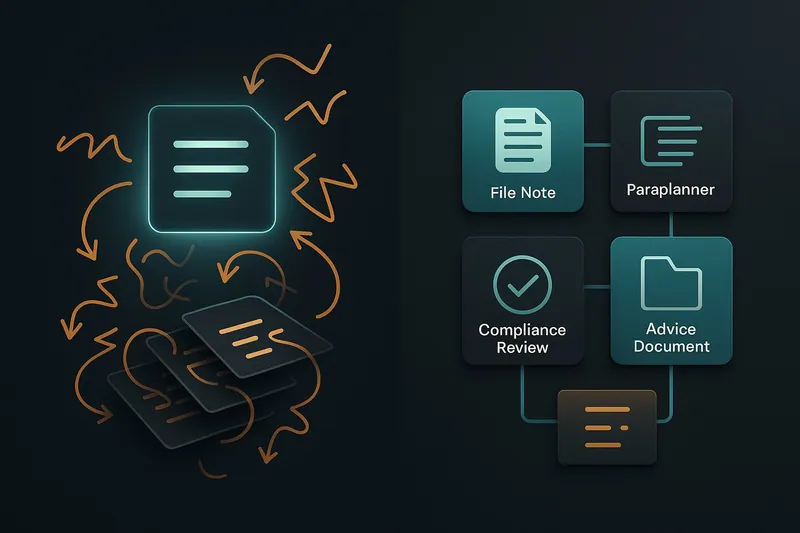
Generic AI note-takers optimise for conversation capture.
Adviser-specific AI platforms optimise for advice production.
Those are not the same category.
One is trying to tell you what was said.
The other is trying to help your firm move from meeting to record, record to workflow, and workflow to advice output without losing context, consistency, or control.
Once you see the distinction, the buying decision gets much clearer.
The four failure points where generic tools break down
This is the free consulting bit.
If you want to evaluate whether a generic AI note-taker is good enough for your firm, do not start with the transcript quality. Test the handoffs. Four failure points usually tell the story.
1. The record is readable but not defensible
Advice records need more than a clean summary.
They need to show the client's relevant circumstances, the issues discussed, the basis for advice, the information relied on, and the decisions or next steps that followed. That is especially important when a firm is using AI in file note production at scale.
ASIC's recent public guidance on consumer AI use is a reminder of the broader direction of travel. AI can help with understanding and summarising. It does not reduce the need for trusted sources, sound judgement, and records that can be checked.
A generic note-taker does not know your record-keeping standard. It does not know when a missing rationale creates risk. It does not know that "annual review completed" is weak evidence if nobody has recorded what was assessed, what changed, and why the recommendation remained appropriate.
An adviser-specific platform can be structured around those requirements by default.
2. The note does not carry the workflow forward
A summary is only useful if the rest of the business can act on it.
That means paraplanners need a clear brief. CSOs need explicit next steps. Compliance teams need predictable structure. Advisers need the output to line up with how the firm already reviews and delivers advice.
Generic tools usually stop at the summary.
That creates a hidden tax. Staff spend time translating one output into the next format each team actually needs. The same meeting gets reinterpreted three times across three roles. Firms then blame the people for slow turnaround when the real problem is the artefact never fit the process.
3. The tool cannot enforce house standards
This is where multi-adviser firms quietly lose consistency.
One adviser edits heavily. Another accepts the default wording. A third changes the structure because they prefer a different flow. After a few months the practice has a shelf full of notes that all came from "the same AI tool" and still look like they were written by five different businesses.
That inconsistency hurts more than people think.
Review times increase. Paraplanners learn which advisers require extra interpretation. Compliance exceptions cluster around format drift and missing detail. The firm has bought speed for the front end and chaos for the middle.
Advice-specific platforms are valuable here because they can force the output into the firm's approved structure, language, disclaimers, and workflow logic. The point is not creativity. The point is predictability.
4. The governance story falls apart the moment someone asks a hard question
Joe Longo said in March that ASIC wants to be a backer, not blocker, of financial innovation. That is a green light for disciplined adoption, not a free pass for sloppy implementation.
Boards and licensees still need to know what the system is doing, what data it can access, where outputs go, and how staff review those outputs before they become part of the advice record.
Generic note-takers are often fine until someone asks basic operating questions.
Where is the data processed. What permissions exist by role. Can the tool map outputs to your file note standard. Is there an audit trail. Can it flag missing elements before the file moves on. Can it fit your oversight model rather than forcing you into the vendor's default behaviour.
If those answers are vague, the savings are vague too.
Why this matters more in 2026 than it did in 2025
Two trends are colliding.
First, consumers are getting more comfortable with AI in financial contexts. ASIC's latest Moneysmart research says 18% of Gen Z Australians are already using AI platforms for financial information and 64% say they trust AI platforms for money advice.
Second, advice firms are putting AI deeper into the workflow. Adviser Ratings says file notes are already the highest-penetration AI use case in Australian advice practices.
That combination raises the bar.
When clients arrive with AI-generated expectations and firms respond with AI-generated records, the quality of the internal workflow matters more, not less. A generic summary tool might have been good enough when AI sat at the edge of the process. It is much riskier once AI becomes part of the record production chain.
The operational difference shows up in paraplanning first
If you want the fastest way to test whether your current AI note setup is helping, ask your paraplanners.
They will tell you quickly.
A useful note gives them scope, context, rationale, and clean next actions. A weak note gives them a transcript, a summary, and an archaeological dig.
That is usually where the false economy becomes obvious. Firms buy a cheaper note tool to save adviser time, then spend the savings several times over in paraplanning clarification, review loops, and document rework.
No serious advice business should optimise only for the first five minutes after a meeting.
It should optimise for the full path from meeting to usable record to advice output.
What to look for instead
If your firm is evaluating AI note-takers now, a better shortlist starts with workflow questions rather than feature checklists.
Look for a platform that can produce a file note in your house structure, not a vendor's favourite summary format.
Look for one that can capture the basis for advice, not just the conversation highlights.
Look for one that supports adviser, paraplanner, compliance, and client service handoffs instead of treating the adviser as the only user who matters.
Look for one that keeps an audit trail and supports controlled review before records are finalised.
And look for one that can carry the work forward into adjacent outputs, whether that is a paraplanner brief, an ROA draft, an SOA section, or a follow-up task list.
Those capabilities matter more than whether the interface looks clever.
This is where adviser-specific platforms earn their keep
An adviser-specific AI platform is not valuable because it is more niche.
It is valuable because it understands the shape of the work.
It knows a transcript is input, not the record. It knows advice teams run on structured handoffs. It knows a file note needs to support downstream production, not just document that a meeting happened. It knows governance is part of the product, not a legal appendix.
That is why advice-specific systems are better positioned to support compliant file notes, ROA and SOA workflows, and consistent records across a team.
At AdviseWell, that is the lens we care about most. The aim is not to help one adviser write a nicer summary. It is to help the whole firm produce cleaner records, reduce rework, and move advice work forward with more consistency and control.
The real buying decision
Most firms think they are choosing between a cheap tool and an expensive tool.
They are usually choosing between a cheap-looking tool and an expensive workflow.
That is the inversion.
If the note-taker only saves time for the person leaving the meeting, it is not really solving the business problem. The firms that get value from AI in advice are the ones that evaluate tools at the workflow level: record quality, handoff quality, review quality, and governance quality.
Everything else is demo theatre.
As AI moves deeper into Australian advice, the winners will not be the firms with the most tools. They will be the firms whose records still make sense three steps later, three months later, and three years later.
That is why the generic-vs-specific choice matters.
It is not really about note-taking at all.
It is about whether your AI helps produce advice work, or just produces more of it.
The difference is easier to judge on a real meeting than on a feature list. Run one of your transcripts through our free AI file note generator and compare what comes back with the summary your current tool produces.
Share this post:
Discover AdviseWell
Learn more about who we are, what we’re building, and how we’re shaping the future of advice.