October 19, 2026 · 4 min read
AI and superannuation advice: faster work, harder questions
AustralianSuper plans staged online advice; separately, regulators scrutinise AI. Where can AI help advisers without missing rollover risks?
Four practical areas to review in an advice file note: client circumstances, reasoning, disclosures and the information relied on.
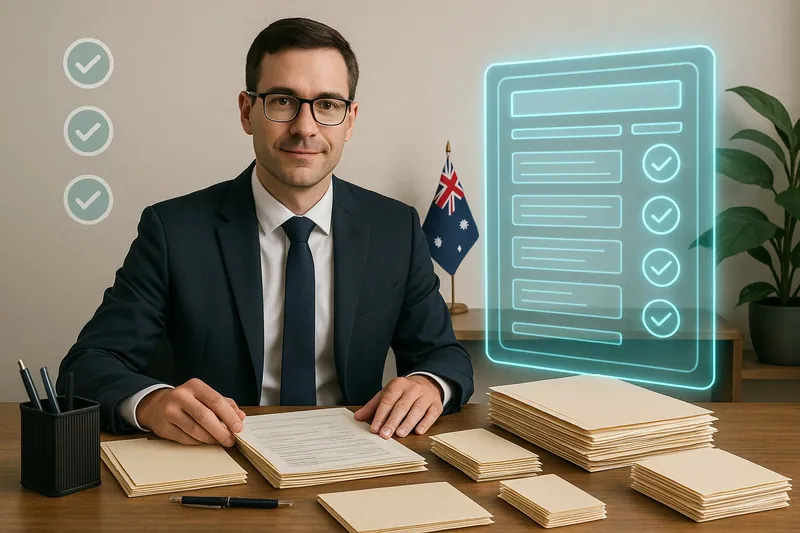
File notes are usually treated like admin. That is the mistake.
In practice, file notes are the operational backbone of defensible advice. When advice is reviewed, challenged, remediated, or handed over, the file note is often the clearest record of what happened, why it happened, and what the adviser relied on at the time.
Documentation pressure grows when a firm has more client work than its experienced team can comfortably prepare and review. File-note standards need to hold up under that pressure.
Across the firms we work with, the pattern is consistent. Advice teams know record-keeping matters. They also have inconsistent habits, different templates, patchy meeting capture, and file notes that depend too heavily on individual judgement.
That inconsistency is the problem.
A weak file note is rarely the result of adviser laziness. More often, the rationale, client context, disclosures, and evidence trail were simply never captured in a repeatable way. One adviser records three paragraphs. Another records three lines. A paraplanner fills the gaps from memory. Compliance tries to interpret intent after the fact.
That is where risk creeps in.
ASIC RG 175 explains conduct and disclosure obligations for financial product advisers. The applicable record-keeping requirements depend on the service and circumstances; use the current guide, relevant instruments and your licensee's requirements.
Check the current ASIC RG 175 and applicable instruments with your compliance team. This article provides practical review prompts, not an exhaustive statement of legal requirements. Showing the recommendation alone does not explain the information relied on or the reasoning behind it.
This is where firms need a more operational view of compliance. A file note should be a structured business record, not a free-text diary entry.
The simplest way to think about it is through four elements. If your file note consistently captures these four, you are in a much stronger position with compliance, supervision, remediation, and client servicing.
Start with the client's relevant circumstances at the time the advice was given.
This sounds obvious, but it is where many file notes become too generic. "Discussed retirement goals" is a useless record. "Client intends to retire at 62, expects $85,000 p.a. net spending, has no debt, and wants to retain access to capital for aged care contingencies" is a useful one.
Capture the facts that actually shaped the advice. That usually includes:
If it is further advice, record what has and has not changed. That is especially important where a Record of Advice, or ROA, is used instead of an SOA.
Before using an ROA instead of a new SOA, confirm the applicable legal pathway and all its conditions with your licensee, compliance team or legal adviser. A short checklist cannot determine eligibility. Record:
Whatever the applicable pathway, the file note needs to evidence why it was appropriate. If you are relying on an ROA, the file note should state the basis for that reliance in plain terms.
The second element is the reasoning behind the advice.
This is where you connect the client's circumstances to the recommendation. Many file notes jump from meeting discussion straight to action items. That leaves out the most important part: the adviser's judgement.
Capture:
This does not need to be a long essay. It does need to show a rational chain.
For example, if a client is moving from accumulation to pension phase, the file note should record more than "recommended account-based pension". It should capture the factors considered: income needs, tax treatment, estate planning preferences, liquidity needs, social security impacts, and whether alternatives were assessed.
The same applies to insurance, debt recycling, contribution strategies, platform changes, and portfolio adjustments. The basis for advice should be visible to someone reviewing the file later who was not in the room.
Here is the test I use with firms. Could a competent reviewer understand the recommendation and the reasoning without asking the adviser to reconstruct it from memory six months later.
If the answer is no, the file note is unfinished.
The third element is disclosure. This is where firms often rely too much on templates and too little on evidence.
Templates matter. They create consistency. They do not prove a disclosure occurred.
Your file note should record relevant disclosures made to the client, including:
If the client made a decision after a discussion about trade-offs, record that discussion. If the client chose a lower cover amount after affordability concerns were explained, record it. If implementation was delayed because the client wanted time to consider tax consequences, record it.
A defensible file shows what was explained, what the client understood, and how that affected the next step. Attaching a document and assuming it speaks for itself does not do that.
The fourth element is the information relied on in preparing and reviewing the advice.
Record the inputs that informed the advice and the selection process, so the basis can be reviewed. This is a practical documentation recommendation; your compliance team should confirm the applicable legal requirements.
This may include:
A good file note can reference the source documents relied on, provided the links are clear and the records are retrievable. The point is not duplication. It is evidentiary integrity.
If someone asks, "What information did you rely on in concluding this was in the client's interests and prioritised appropriately", the answer should be available from the file itself.
Once teams understand the four elements, the next issue is operational: what should go into the note every time.
Here is a practical minimum standard I recommend.
Record the meeting context. Date, time, attendees, adviser, and whether the interaction was in person, by phone, or video.
Record the purpose of the interaction. Annual review, further advice, insurance needs analysis, contribution strategy, pension commencement, implementation follow-up, or something else specific.
Record the client's current position and any change since the last advice interaction. Be precise. If nothing material has changed, say that and note the basis for that conclusion.
Record the decisions under consideration. This keeps the file note anchored to the actual advice issue.
Record the recommendation and the reasoning. Include assumptions, alternatives considered if relevant, and any scope limits.
Record disclosures and warnings provided. Especially where advice is limited, product replacement is involved, or the client declines part of a recommendation.
Record the information relied on. Reference the documents, modelling, research, or client instructions used.
Record the client response. Agreed, requested time, declined, asked for revision, or approved implementation.
Record next steps and responsibility. Who is doing what, by when.
That sounds simple because it is. The difficulty is consistency across every adviser and support team member, every time.
The adviser shortage has changed the economics of documentation.
When a practice is stretched, file notes get delegated, delayed, shortened, or completed from fragments. That is understandable. It is also where quality drops fastest.
Paraplanners feel this pressure acutely. They are often reconstructing advice intent from meeting recordings, emails, CRM entries, and half-finished notes. Compliance teams then inherit variability that is hard to supervise at scale.
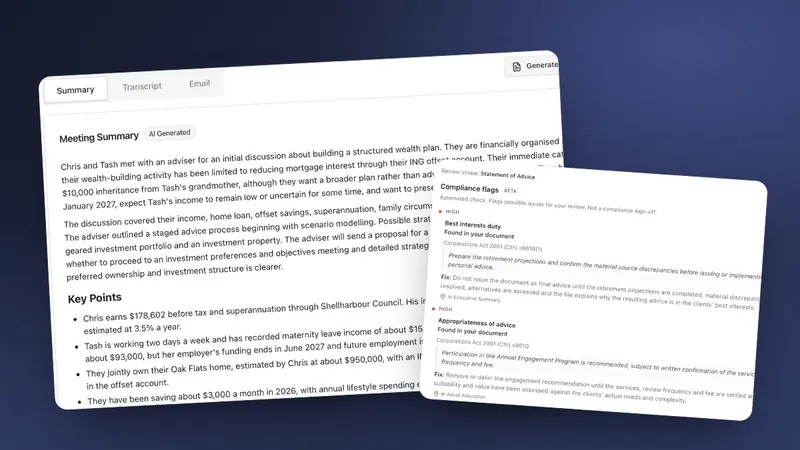
File-note preparation is a practical place to test AI because the task is repetitive and has a clear review point. Measure whether a tool improves the completed record, including corrections and filing.
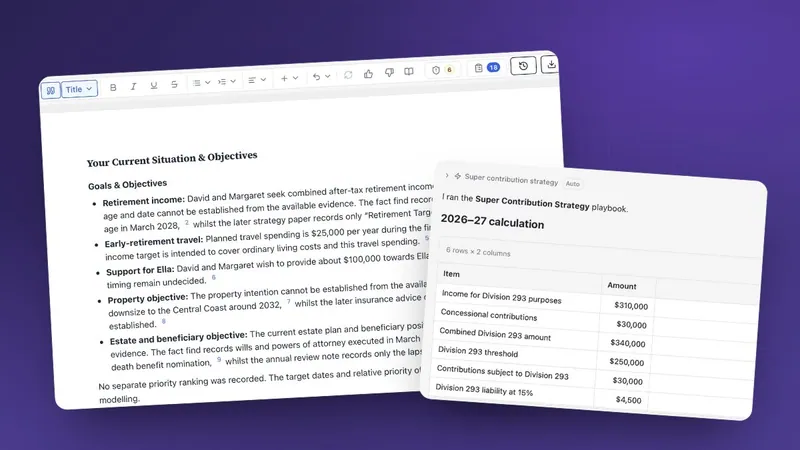
File note generation is time-intensive, repetitive, and structure-dependent, so AI is well suited to turning a transcript or meeting summary into a first draft.
Used properly, it can standardise output and reduce the blank page problem. Used poorly, it can create polished records that are incomplete, inaccurate, or impossible to defend.
A generated file note is still your record. If the AI inferred facts that were never said, omitted a disclosure, or mischaracterised the client's priorities, the risk sits with the firm.
Consumer willingness to use AI does not reduce the firm's responsibility to supervise its advice process.
AI can help produce better file notes. It does not remove the need for adviser judgement.
The right use of AI in this context is narrow and practical:
The wrong use is treating AI output as a finished compliance record without review.
In most firms, the best model is human-led, AI-assisted. The adviser or authorised staff member remains responsible for verifying that the note accurately reflects the interaction, the basis for advice, and the information relied on.
That review step should be explicit in your process.
I also recommend firms avoid generic prompting for file notes. Generic prompts produce generic records. Build a standard structure aligned to your advice process, your approved wording, and your supervision expectations.
For example, if your team regularly uses ROAs, make the AI workflow require an explicit field for why the ROA path is available. If your compliance reviews focus heavily on client interest priority, require the workflow to capture the source information relied on and any alternatives considered.
Firms often need operational design as well as a tool.
At AdviseWell, that is the part we spend most time on: helping firms turn compliance expectations into repeatable workflows and AI-assisted processes that still preserve review, accountability, and evidence quality. The technology matters. The process design matters more.
related: Automate the full SoA
If you want a simple test for your current file notes, use this.
Take ten recent client files across different advisers. Remove the adviser's personal context and read the notes cold.
Can a reviewer identify:
If those answers come easily and consistently, your process is working. If they depend on who wrote the note, your firm has a process design problem.
File notes are the record that holds the advice process together when memory fades, staff change, clients complain, or ASIC asks for evidence.
The firms that do this well tend to treat file notes as part of advice production. The shift from "admin after the meeting" to "part of the advice workflow" sounds small, but it changes how the team works.
A useful review checks the client's relevant circumstances, the reasoning behind the advice, the disclosures and client response, and the information relied on. These four areas are practical review prompts, not a guarantee that a file meets every applicable obligation.
Start with the current ASIC RG 175 and the applicable record-keeping instruments. Your compliance team should confirm the provisions and requirements that apply to the service and circumstances.
Could a competent reviewer understand the recommendation and the reasoning without asking the adviser to reconstruct it from memory six months later? If not, the file note is unfinished.
Meeting context (date, attendees, channel), the purpose of the interaction, the client's current position and any change since last advice, the advice and reasoning, disclosures and client decisions, and references to the source documents relied on.
AI can produce structured, consistent first-draft file notes from meeting capture, with the four elements built into the template. The adviser remains responsible for accuracy and judgement; the gain is consistency and a repeatable evidence trail rather than free-text diary entries.
To test the shape of a note, start with fictional or approved material in our free AI file note generator. It returns the note, the client facts that were stated, and the gaps a reviewer would ask about. No account needed. The AdviseWell features page shows how file notes fit the rest of the advice workflow.