October 19, 2026 · 4 min read
AI and superannuation advice: faster work, harder questions
AustralianSuper plans staged online advice; separately, regulators scrutinise AI. Where can AI help advisers without missing rollover risks?
AI is unlikely to replace financial advisers. It is changing how advice work gets done. Three likely outcomes, with the data behind each.

Kinda. AI is not going to replace financial advisers in Australia. It is going to replace many of them with the ones who use it well.
That is the answer to a question being asked at every adviser dinner, every PI insurance review, and every adviser firm board meeting in 2026. The framing is wrong, and the wrong framing is producing the wrong response.
Walk into any practice in the country right now. Half the advisers are betting AI will go away or stay shallow enough to be a tool the paraplanner uses. The other half are already rebuilding their week around it. The data already shows which half is going to keep their book.
The Australian adviser population fell from roughly 28,000 in 2018 to under 15,600 by the end of 2024, according to Adviser Ratings. The Royal Commission, FOFA, and the FASEA standards explain most of that drop. None of them explains the next one.
The next leg down is being driven by clients who Google the answer first, by competitors who serve a hundred clients with the load that used to take fifty, and by a regulator that does not care which tool produced the document if the document is wrong.
The Quality of Advice Review (Levy, December 2022) said the binding constraint on access to advice in this country is the cost of producing it. The Treasury Laws Amendment (Delivering Better Financial Outcomes) Act 2024 picked off Tranche 1 of the recommendations. Neither the report nor the legislation changes the underlying maths. Advice production cost is still high, and the firms that drop it without dropping the quality are the firms that take the next decade.
That is what AI is doing, unevenly, desk by desk. The desks where it is happening fastest are not the ones with the biggest tech budget. They are the ones where a single principal decided, at some point in the last twelve months, that the way the practice produces a Statement of Advice was no longer fit for the cost it took to produce.
Once one firm in a regional market shifts, the others have a quarter to follow. Maybe two. The clients see the difference at the second meeting.
If you think the question is "will AI replace advisers," you will spend the next year defending your value proposition against a chatbot. That is the wrong fight. The chatbot is not your competitor.
The adviser two suburbs over who has integrated AI into their fact-find, their SOA workflow, their review preparation, and their compliance review is your competitor. They are charging the same fee. They are taking three times the clients. They are still inside ASIC RG 175 and Section 961B of the Corporations Act, because the best-interests duty does not change when the document is drafted faster.
The right question is which advisers.
There are three outcomes for an Australian adviser between now and the end of 2027. Pick where you want to land before the market picks for you.
The advisers who treat AI as next year's problem. They keep the same SOA cycle, fact-find and paraplanner pipeline, so cost per client and throughput stay unchanged. The fee schedule has to stay flat because the cost base has stayed flat.
Their competitor has cut twenty hours per SOA. The competitor passes that saving to the client or absorbs it as margin. The Outpaced adviser does neither. Their book stops growing first. Then it shrinks as renewals walk to firms that look cheaper and faster for the same scope.
This is the bucket the Quality of Advice Review was implicitly describing when it named cost of production as the binding constraint on access. AI does not change that constraint for the Outpaced adviser. It widens the gap.
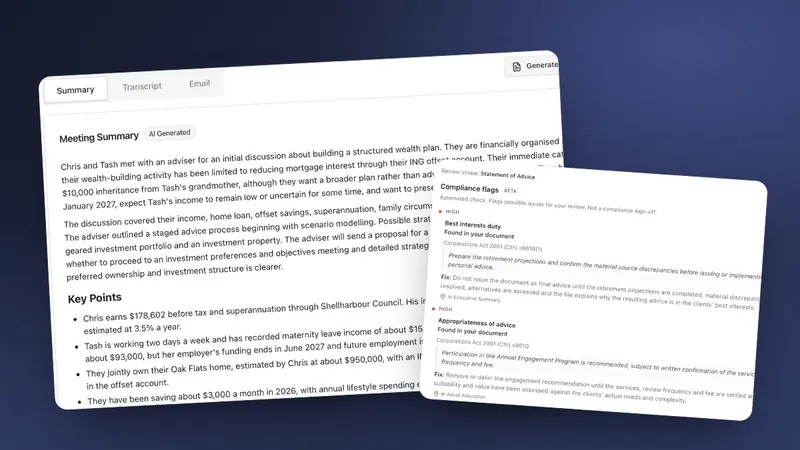
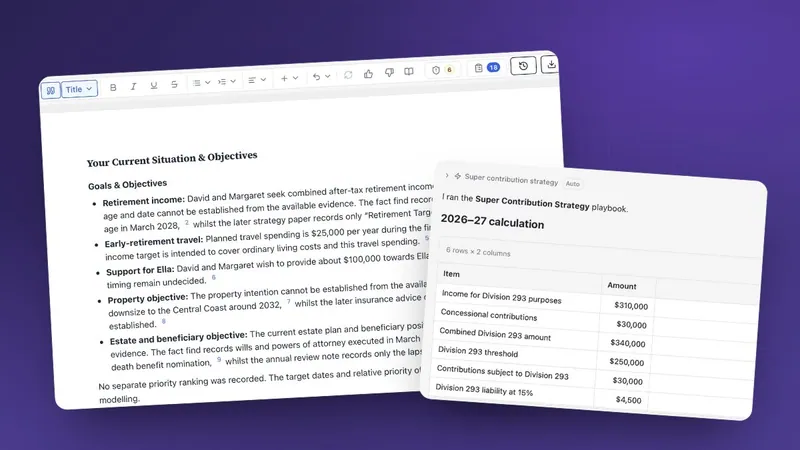
The advisers who use AI for the routine. File note drafts. SOA first cuts. Fact-find updates from email threads. Compliance review of their own work before it goes to the supervisor.
The Augmented adviser saves time on the parts of the work that were never their value-add. Client meetings stay where they are. Judgement calls stay where they are. Relationship work stays where it has always been. AI rebuilds the rest of the week.
This is the median outcome. Most advisers will land here by 2027, and the firms that pick this position deliberately will be in better shape than the firms that drift here by accident. Drift produces a stack of subscriptions and an inconsistent governance posture. Deliberate placement produces a clean operating model.
The smaller group, and the one that grows the books fastest.
The Indispensable adviser uses AI to compress the routine and then redeploys the freed time into work AI structurally cannot do. The hard conversation about a parent's care. The grey-zone strategy when a client's marriage is collapsing during a property settlement. The judgement call between two technically compliant strategies, where one will sit better with the client at age 70. The interpretation of a family business handover where four generations want different things.
These are the work AI does not replace, because the work is shaped by conversation, ethics and judgement, not documents. The Indispensable adviser charges the same fee as before for half the document work and twice the strategic work. The book grows. The fee per client grows. The firm acquires referral velocity that the Outpaced adviser used to have.
There is a second-order effect that is easy to miss. The Indispensable adviser becomes the one their peers call for the hard cases. The practice that handles the hard cases keeps the wealth-bracket clients who outgrow simple advice. The fee per client compounds, the complexity per client compounds, and the AI-augmented operating model is what makes the economics work at the new scale.
Pick three workflows in your practice from the last fortnight. For each one, name the part that was document work and the part that was judgement. The boundary is rarely where advisers think it is. Most fact-finds turn out to be 80% document work. Most strategy meetings turn out to be 80% judgement. Most SOAs turn out to be 50/50, with the split obscured by the formatting.
Now run the test. Could AI have produced the document part to 80% quality without judgement input? If yes, that part is going to AI inside two years whether you act or not. The decision is whether your practice captures the time saving or pays a competitor for it.
Then do the second pass on the judgement parts. Are they being given the time and attention they deserve, or are they being squeezed by the document work eating the calendar? The Indispensable adviser is not working harder. They have shifted the weight.
This is a thirty-minute exercise, done once, that tells you which Outcome you are heading toward by accident. The deliberate version of the answer is what AdviseWell exists to support, but the diagnostic itself does not need a vendor. A pen and the last fortnight of your calendar are enough.
The question keeps coming up at every committee, so name it directly.
ASIC does not require you to use AI. ASIC also does not exempt you from RG 175 if you do. The Corporations Act sits where it has always sat. The best-interests duty under s961B sits with the licensed adviser, not the model. The record-keeping floor under s912G is seven years, regardless of who typed the first draft.
Outcome 2 and Outcome 3 advisers know this. They built the audit trail at the same time they built the AI workflow. Outcome 1 advisers cite the regulator as the reason for inaction, and the regulator they cite is one ASIC published the rules for two decades ago.
Compliance is not what is stopping the Outpaced adviser. Posture is.
AI is sorting the population of advisers into Outpaced, Augmented and Indispensable. The sorting is happening quarterly rather than annually, driven by the firms that have already moved.
The question "will AI replace financial advisers in Australia" asks about the population, when the answer depends on the individual. The next time it comes up at an adviser dinner, the better answer is: it depends which adviser.
Look around the table. The sorting has already started.