October 19, 2026 · 4 min read
AI and superannuation advice: faster work, harder questions
AustralianSuper plans staged online advice; separately, regulators scrutinise AI. Where can AI help advisers without missing rollover risks?
What agentic AI actually means for Australian advice firms. Practical use cases, governance requirements, and how it changes advice operations.
Most Australian advice firms have already started using AI.
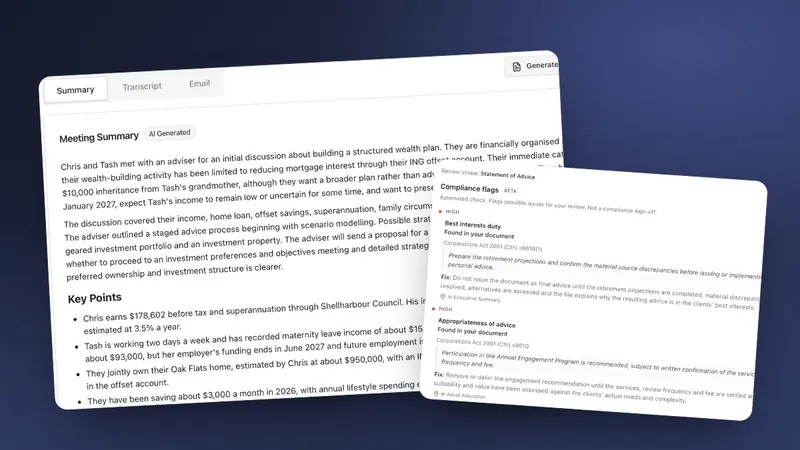
In practice that usually means meeting summaries, file notes, draft emails and perhaps some document search. That first wave of AI has helped firms shave time off narrow tasks. It has not changed how advice work moves through the business.
Agentic AI for financial advisers goes further than writing. It can plan, sequence work, use tools, move across systems, and complete multi-step workflows within clear limits.
It matters now because the market is moving. Adviser Ratings’ 2025 Landscape Report found 74% of Australian advice practices are using or planning to use AI, with file notes at 86% penetration. Broadridge’s 2026 Digital Transformation Study says 57% of financial services firms are making moderate-to-large investments in agentic AI. KPMG estimates global spend on agentic AI hit US$50 billion in 2025. Wolters Kluwer says 44% of finance teams will use agentic AI in 2026, a rise of more than 600%.
So this is no longer a fringe topic. The questions for your firm are what agentic AI means in practice, and what it would take to use it safely in a regulated advice environment.
At most firms, AI sits beside the workflow, not inside it. An adviser records a meeting. AI creates a summary. Someone checks it. Another person copies key points into the CRM. Someone else starts the fact find updates. Paraplanning picks up the strategy work later. Admin chases missing data. A draft email goes out. The SoA queue grows. Review tasks sit in another system. Service periods tick over in the background.
Each AI interaction might save a few minutes, but the workflow itself is still fragmented. Your bottlenecks do not disappear. They move around.
You still rely on people to push work from one stage to the next. You still lose time to handoffs. You still create risk when information is re-keyed across systems. You still struggle to see where a case is actually up to.
Advice workflow automation differs from task automation. Task automation helps with isolated activities. Workflow automation changes how work progresses end to end. Agentic AI sits in the second category.
In plain English, agentic AI does more than respond to a prompt. It can:
In financial advice, the useful version of agentic AI is a controlled system that takes bounded actions inside a governed process. It does not act autonomously without limits.
For example, after a client review meeting, an agentic workflow might:
That is a very different model from “write me a meeting summary”.
It is also why people talk about an AI operating system for financial advice rather than AI tools. The idea is orchestration. It coordinates the work, the systems, the permissions, and the audit trail.
A copilot waits for instructions. An agent works toward an outcome.
Most firms today are using copilot-style AI. You prompt it. It gives you an output. A human decides what happens next.
That model is still useful, but it has limits in an advice business where the real cost sits in process friction. The practical difference:
That is why agentic AI in wealth management is getting attention. Wealth businesses are operationally complex. They run on recurring processes, service calendars, compliance checks, documents, task queues, client communications, and review cycles. That is exactly the kind of environment where orchestration matters.
When people hear agentic AI, they often jump to extreme scenarios: fully automated advice, no humans, black box recommendations. Most firms should not start there.
The immediate value is operational: less admin drag, more consistency, and work moving through the firm with fewer delays and manual handoffs.
This is one of the clearest use cases. Today, a lot of firms capture the meeting and stop there. The summary exists, but the downstream work still depends on manual follow-up.
An agentic workflow can take the meeting output and turn it into structured action.
The gain is continuity as well as speed. The information does not stay stuck in a note.
Many firms lose time before advice work even starts properly.
Cases arrive incomplete, scope is unclear and supporting documents are missing. Staff spend hours chasing basics before any technical work begins. Agentic AI can help standardise intake and triage.
Bad inputs create slow, expensive advice.
Paraplanning teams are often carrying the cost of messy upstream processes. They receive incomplete files, inconsistent notes, unclear scope, and half-finished admin work. Turnaround times then blow out.
Agentic AI can improve the handoff into paraplanning by preparing a cleaner brief.
That does not replace paraplanners. It reduces the waste around them.
Document generation is another area where firms often confuse drafting with workflow.
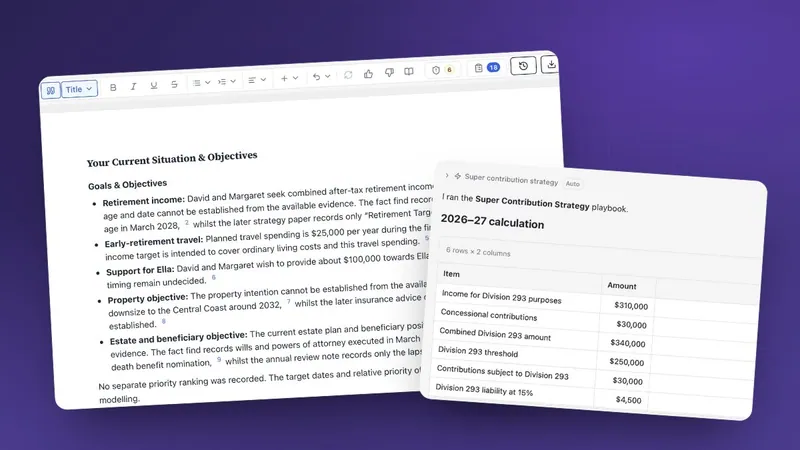
A generative AI tool can produce a draft paragraph, but the real process involves much more:
Agentic AI can coordinate these steps, with humans approving where required.
Agentic AI is process control, not content generation.
Post-advice service is full of recurring obligations and recurring risk.
It includes annual reviews, consent renewals, service tracking, client outreach, fee renewal tasks, review packs and missed milestones. Firms can leak both revenue and compliance confidence here.
Agentic workflows can support ongoing service by:
Compliance teams deal with workflow problems as well as document problems.
Agentic AI can support internal controls by helping to:
The AI should support control processes within set bounds, not replace accountable people.
Agentic AI can take actions, so governance matters more than it does with a simple drafting tool.
If your firm is considering agentic systems, ask more than “can it automate this?” Ask what it is allowed to do, under what conditions, and with what oversight. That means boundaries.
Without those controls, agentic AI becomes a governance problem very quickly.
In a regulated environment, you need more than a good output. You need evidence.
If an AI-driven workflow updates records, drafts client communications, routes work, or triggers service events, your firm should be able to show:
This is especially important when you think about complaints, breach assessment, and supervisory review.
ASIC’s February 2026 update put clear attention on governance, complaints handling, breach reporting, and outsourcing. These bear directly on how AI should be deployed in advice businesses.
Some firms still treat AI procurement like ordinary software procurement, which is risky. If a third-party platform is involved in advice operations, record handling, workflow execution, or client communications, your outsourcing and operational risk disciplines still matter. You need to understand:
Calling something AI does not remove your accountability.
On 6 March 2026, ASIC Chair Joe Longo said ASIC wants to be “backers, not blockers” of financial innovation. He outlined support for AI advice tools moving from sandbox settings toward full licensing pathways.
That suggests ASIC recognises AI-enabled advice tools are moving into the mainstream. The question is no longer whether these tools should exist. The question is how firms can use them within proper governance, licensing, and consumer protection settings.
That lines up with ASIC’s broader direction. Where AI is involved, ASIC appears focused on whether firms can demonstrate:
That is a workable position for advice firms. Innovation is possible, but not on a “set and forget” basis, and firms that build controls early will be in a stronger position than firms that bolt governance on later.
You do not need a huge AI strategy before you start, but you do need a baseline level of operational readiness. Agentic systems amplify whatever process quality already exists. If your workflows are inconsistent, your data is unreliable, and your responsibilities are fuzzy, the AI will not fix that. It will expose it.
Before adopting agentic AI for financial advisers, check your readiness in five areas.
If you cannot clearly map how work moves from intake to advice delivery to ongoing service, you are not ready for workflow automation.
You need to know:
You do not need perfect process maps. But you do need enough clarity to define rules and boundaries.
Agentic workflows rely on structured, accessible data.
If key client information lives in inconsistent notes, disconnected systems, and staff memory, your results will be patchy. The better your underlying data discipline, the better the automation.
Ask yourself:
Not everyone in your firm should be able to do everything. The same applies to AI agents.
You need role-based permissions that reflect your actual operating model. That includes who can:
If your access controls are loose today, fix that before expanding automation.
AI governance should not sit in a vague shared bucket between IT, compliance, and operations.
Someone needs clear accountability for:
In many firms, this will be shared across functions. That is fine. But ownership still needs to be explicit.
If your plan is to bolt agentic AI onto broken workflows and hope for the best, you will be disappointed.
The firms that benefit most will rethink how work should flow in the first place. They will simplify handoffs, reduce duplicate handling, standardise case types, and define where humans add the most value.
That is what makes an AI operating system for financial advice useful: it becomes part of how the firm runs.
Most AI demos look impressive for ten minutes. The test is whether the platform can operate inside the messy realities of an advice firm. Ask practical questions:
If the answers are vague, the platform is probably not ready for serious advice operations.
There is a lot of hype around agentic AI, and some of it is deserved. The advice market is moving beyond one-off AI prompts toward systems that can coordinate work. Advice businesses are operational businesses, so capacity, consistency, control and turnaround time all matter.
Agentic AI could improve how your firm runs if you treat it as an operating model decision rather than a novelty purchase. That means starting with workflows, controls, permissions, and accountability. Then using AI to move work through those structures more effectively.
Rather than treating AI as a standalone assistant, AdviseWell is designed as an AI operating system for financial advice. The focus is on helping advice firms orchestrate workflows across the client journey, with structured processes, bounded actions, visibility, and governance built in.
This suits firms that want more than note-taking and drafting, and want AI to help move work from meeting capture through to advice operations and ongoing service, without losing control of approvals, permissions, and auditability. For firms already working in Claude, AdviseWell's Claude Cowork connector brings that same governed workflow into the tools your team uses today.
A growing advice firm does not need more disconnected tools. It needs fewer manual handoffs, cleaner workflows, better visibility, stronger controls, and a practical way to use AI that fits a regulated business. For your firm, agentic AI should mean a better way to get advice work done.
Agentic AI is AI that can plan, sequence work, use tools, move across systems, and complete multi-step workflows within defined limits, rather than just responding to a single prompt. In an advice firm, that means it can turn a meeting into fact find updates, paraplanning briefs and follow-up tasks as one coordinated process, with human approval built into the workflow.
No. A copilot waits for instructions and produces one output at a time, usually for drafting, summarising or searching. An agent works toward an outcome: it can trigger actions based on events or workflow state, coordinate multiple systems, and route work to the right person, all within permissions and boundaries a firm sets.
ASIC has signalled it wants to be a backer, not a blocker, of AI-enabled advice tools moving from sandbox settings toward full licensing pathways. In practice, that means it is focused on whether firms can demonstrate clear accountability, appropriate supervision, good governance, effective complaints handling, sound breach reporting and proper management of outsourced providers, not on stopping agentic AI outright.
Most firms have automated individual tasks, such as meeting summaries or draft emails, while the surrounding workflow stays fragmented and still depends on people to push work from one stage to the next. Agentic AI automates the workflow itself: it can sequence tasks across systems, escalate exceptions to a human, and keep an audit trail of what happened and why.